

Hey friends, it’s Albi here, fresh off a “viral” IG moment that’s got me rethinking endless scrolls and those blank-brain moments in conversations. And speaking of that, if you’ve seen my video (60k + views and counting!), you know the drill: “Why do some people sound intelligent in every conversation… and others sound like they forgot how to speak? It’s not IQ. It’s articulation reps.”
To those who are new, welcome to the crew fighting brainrot and building unbreakable agency! Excited to have you here; let’s turn passive scrolls into powerful reps starting with your first challenge. What’s your biggest NPC glitch right now?
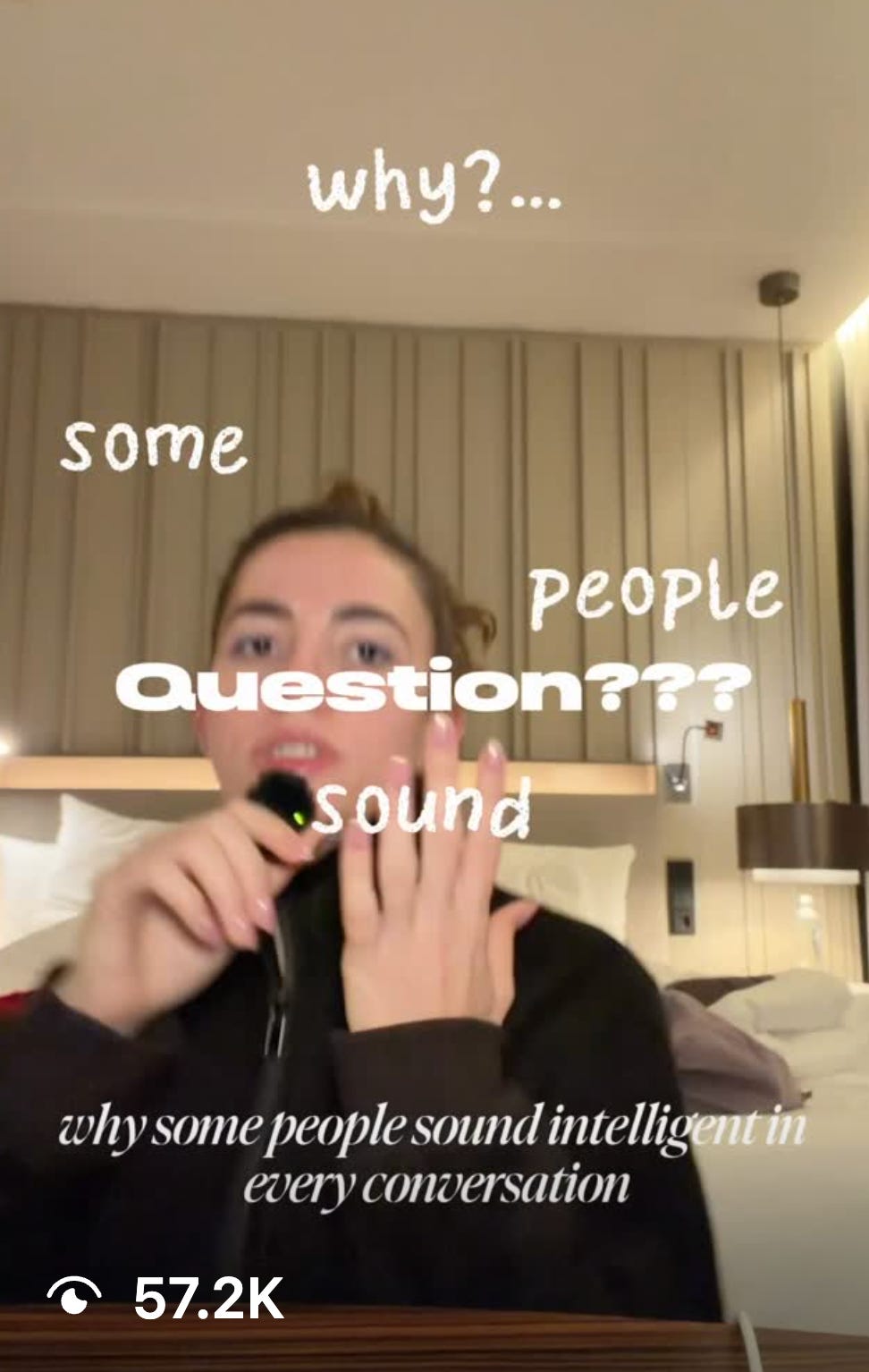
see the post here: https://www.instagram.com/insights/media/3842846202560071195/
That clip hit hard because it’s relatable AF, we’re all consuming info like pros, but when it’s time to have opinions? Crickets.
Speaking of crickets, today, I’m diving into how building “articulation muscle” pulled me out of NPC mode (you know, that autopilot feeling where life’s just happening to you), tied to my Whoop/X experiment showing brainrot’s a real pandemic.
We’ll connect the dots to emotional macronutrients, like tagging tweets as positivity or snark, sonder realizations, and why curating your info diet is the meta-skill for reclaiming agency through my story. As recent articles warn (like those in the New Yorker, and Harper’s on AI’s societal traps), agency and ambition go hand in hand, if you don’t build them, you risk sliding tino a “permanent underclass” where AI handles the work and leaves passive consumers behind. But articulation reps? That’s your daily grind to boost agency and escape the AGI move.
Let’s dive right into the spark: the video.
Plus, actionable steps to try, because if I can shift from scroll zombie to owning every chat, so can you.
The Viral Wake-Up: Articulation Reps to Escape NPC Vibes
Let’s start with the video that’s blowing up (link here if you missed it, drop your thoughts in the comments!).
The hook was: We binge podcasts, doomscroll feeds, and feel “informed,” but when someone asks us to explain? Brain blank 🤯
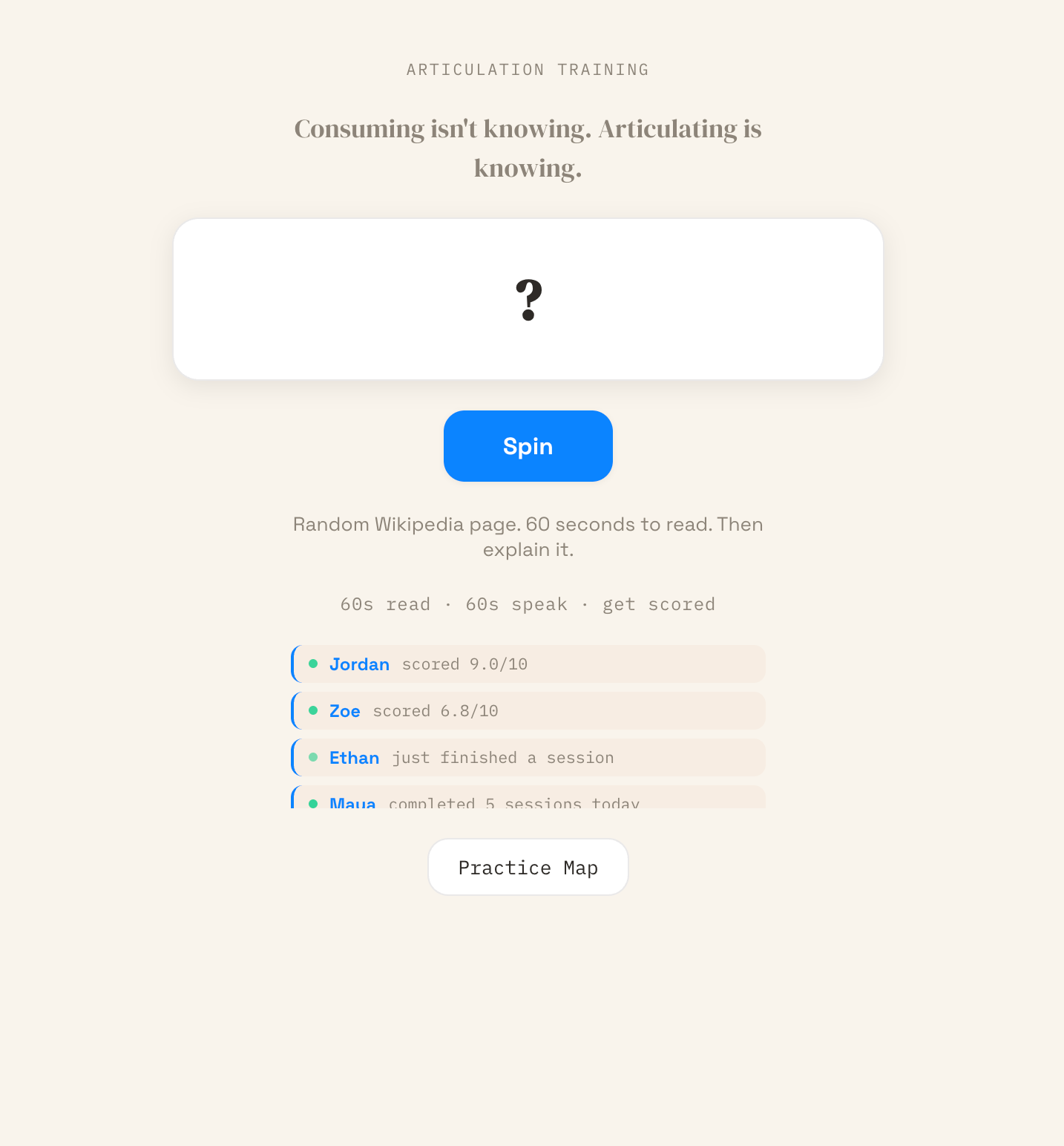
That’s NPC life, non-player character mode, where you’re reacting, not creating. I built this articulation training tool as my escape hatch: Roulette drops you on a random Wikipedia page, 60 seconds to read, text vanishes, camera on—explain for 1 minute.
No notes, no escape. AI scores you on fillers, clarity, structure, and confidence. Rinse, repeat. Why does this save you from NPC vibes?
Consuming isn’t knowing, articulating is.
It’s the mental sparring that builds agency. In my runs (marathon prep, Whoop tracking), I’d notice that post scroll sessions left me foggy, but forcing chats with different groups of people and articulating my thoughts out loud (even mentally) sharpened focus. Or even talking to a friend, I’m literally on a video call right now with my assistant, and she’s watching me write this, because forcing articulation sharpens focus by activating brain regions that cut through the haze.
Tie it to “sonder realizations”, that hit where you grasp everyone’s life is as vivid as yours. Without it, feeds make us NPCs in our own stories.
My obsession with designing apps from an Agency Experience (AX) POV? It’s this: LLMs and never-ending feeds are core interfaces, shift UX to Agency Experience (AX), or stay passive.
Ambition fuels agency, it’s what lets you hustle with AI as an amplifier, not a replacer, to climb out of potential underclass traps.
The stats from the video? Views to 57k, comments to 221, saves to 2.9k, shares to 1.4k, and non-followers to 98% for views/95.8% Mostly non-followers (97%), proving it’s striking a chord.
We’re all fighting brainrot, from socials to llm chats! And guess what? It loops right into the info diet pandemic.
This fight against brainrot? It’s bigger than one video—it’s a pandemic we’re all in.
Brainrot Rising: The Pandemic We’re All Suffering
Stanford’s 2025 study on short-form media (analyzing 338 young adults: https://purl.stanford.edu/zb094wm9033) links heavy TikTok use to impaired attention, memory lapses, and cognitive fog that mimics early declines—think collapsed focus from dopamine overload, hitting teens hardest as their brains wire up.
A 2024 NIH study on self-talk’s neural effects shows that verbalizing thoughts out loud—especially your own voice under pressure- boosts prefrontal cortex activity to regulate amygdala responses, cutting emotional noise and sharpening cognitive focus, much like Huberman’s take on verbal reframing for anxiety control.
From feeds perspective:
x.com/@AugustusDelano put it bluntly: “Scrolling erodes your genius. I’ve felt it: Unless you hit sonder, realizing passersby have epic inner worlds, you’re just NPC-ing through life.”
Tying this to AI’s role in brainrot, AI handles the “what” of creation; humans own the “why” and “how” via articulation. It’s your competitive moat, differentiating work by infusing it with tacit knowledge, relationships, and innovation that AI lacks. In my video, that’s why “articulating is knowing” resonates: It’s the human skill that turns AI tools into amplifiers, not replacers.
But as those articles argue, without ambition-driven agency, AI could lock you into an underclass—daily reps like these are how you break free.
Enter my Whoop experiment,
Tracked X vs. TikTok feeds and Whoop for 6 months.
My results showed that my info diet on X is heavy on positivity (7017 tags), information (6442), insights (6317)—boosting HRV by ~5-10 ms and recovery to 55.7%.
This curation? It’s inspired by @eshear‘s macros, framing “emotional macronutrients” (treats info like food labels for mindful consumption).
TikTok’s leaned on the fluff side: Longer sessions, 92% sleep efficiency drops on aggressive nights. This proves that X can be ultimate brain food when it’s curated. If you don’t articulate, you continue engaging passively, and algorithms exploit that passivity en masse > which becomes a pandemic.
@eshear‘s philosophy empowered my experiment by framing info as ‘emotional macros,’ just like nutrition labels guide eating, info labels do the same for minds.
My experiment’s “nutrition facts” (heavy on positivity) turned X into fuel, not fog. But articulation reps? That’s the gym for your brain—turning passive intake into active output.
To ditch NPC life:
Articulation Quick-Start (5 Mins): Grab a random article (X thread works). Read, hide, explain aloud. Record it, or use this app I built to practice: https://elocute.fun/
Info Diet Audit: Install nutrition facts extension to tag your next 10 scrolls (positivity? Snark?). Aim 50%+ insights. My Whoop showed this spike’s recovery.
Sonder Shift: Next walk/run, people-watch with intent. Articulate one “vivid life” story mentally. This builds empathy and reclaims agency from passive scrolls.
This isn’t just theory; as I’m training for my half and full marathons for April and May, I need to put in the reps, because physical reps are way easier than mental ones for me, as Toastmasters taught me through consistent reps, revealing untapped sides of myself.
So, what’s next for you?
What’s your articulation score? Reply or tag me on X (#ArticulationReps), let’s build agency together.
What I’m Consuming & Where I’m Speaking
Reading Bird by Bird: Some Instructions on Writing and Life
Finished reading: The Gentleman From Peru
Reading,

quote from the above: “Digital life has trained us to look and seek constantly without ever truly meeting, without embodied encounter. The smartphone and social media web inserts between bodies a managed, low-risk, high-stimulation buffer — a prosthesis that makes genuine encounter at once less necessary and also less available. We are perpetually stimulated and perpetually distracted. Exhausted, but never actually nourished, because nourishment requires the kind of contact that the device perpetually defers… We consume the lives of others and somehow lose the thread of our own.” …
“Modern consumer culture, social media, and increasingly therapeutic culture itself have converged on a model of the good life organized around the elimination of discomfort. But transformation is uncomfortable! It requires grief, rage, uncertainty, the willingness to dissolve. These are what are referred to as “negative capabilities” — the capacity to remain in uncertainty and difficulty without grasping after resolution. Our culture pathologizes these states. But they are the very conditions of erotic depth. A culture that cannot tolerate discomfort cannot tolerate eros — and therefore can not tolerate life.”
“When you are erotically alive — truly met, truly seeing, truly present in the charged space of genuine encounter — the first thing that moves through you is not possession but care. Not consumption but offering. The forces that profit from our loneliness have always known this. A person who is erotically alive, specifically and dangerously and with full soul, is a person who cannot easily be kept compliant. Cannot easily be kept buying. Cannot easily be kept alone. The soul that has been genuinely met is harder to colonize. And so they have, in every way available to them, kept us from being met.”
Speaking at https://ethcc.io/
P.S. Be highly ambitious and agentic, Albi