

You know that feeling.
It’s 11:47 pm. You’re in bed. Your thumb is moving but your brain checked out 40 minutes ago.
You’re not watching anything. You’re just… scrolling.
Tomorrow morning, your WHOOP will show a recovery score of 34%. Your HRV will be in the basement. You’ll feel it in your body before you even look at the number.
But here’s the thing nobody talks about:
It’s not just the late ngiht that wrecked you. It’s what you were watching and reading.
I decided to prove it. And along the way, I discovered a tool inspired by Emmett Shear that classifies your X (Twitter) feed like a nutrition label, revealing the “emotional macronutrients” you’re consuming. It’s like if your doomscroll was a bag of chips, and AI was the FDA inspector calling out the junk.
grok, is this real?
I — The Experiment Nobody Is Running
This started with a developer named Dmvaldman, aka RookLift, who merged his Garmin data with chess games on Lichess to predict wins based on sleep https://dmvaldman.github.io/rooklift/. REM was key; stress helped focus. He built an app to flag “smart days” vs. “dumb days.”
But I wanted to apply it to content consumption. Then I remembered that I activated the “emotional macronutrients“ extension on my information diet by Emmett Shear’s (@eshear)) vision.
Emmett Shear, co-founder and former CEO of Twitch, brief interim CEO of OpenAI after Sam Altman’s ousting—first floated the idea in 2022: What if we labeled info like food, tracking “insight”, “snark”, “positivity”, etc.?
In his words, “What emotional macronutrients are in your information diet right now?“ He argues we need tools to balance our feeds, avoiding consumption of negativity or fluff that leaves us malnourished mentally. Humans evolved for nutrient-balanced physical diets, but our info diets are junk food by default. Algorithms optimize for engagement, not well-being.
Fast-forward to 2025: Developer @arithmoquine built the Nutrition Facts Chrome extension based on Shear’s concept. It uses AI (integrated with OpenAI) to tag posts and generate daily “Nutrition Facts” labels. My data shows my X diet is heavy on positivity (7017 tags), information (6442), and insights (6317), but also snark (2741) and aggression (277), and the kicker?
Shear’s motivation? As he explained in posts and interviews, platforms turn us into NPCs in their game. But memes? They’re the glitch in the metrix. Drawing from Aidan Walker’s blogs, memes aren’t just laughs; they’re art, history, and resistance.
III — What I’m Actually Building
Here’s the thesis:
Your biometric data, combined with AI-tagged feed analysis, can reveal which content is good for you, and which is silently wrecking your body and mind.
Not vague: “screen time bad.” Specific: Timestamped HR spikes during “snark” threads vs. stable recovery after “insight” posts. It’s like Faucault’s panopticon, but you’re the watcher turning the gaze on the algorithm.
The experiment stack:
WHOOP Data              TikTok History             X Nutrition Facts
(HRV, recovery, HR)     (videos, timestamps)       (posts, tags like "insight/snark")
         ↓                     ↓                       ↓
         └────────── Time-aligned merge ───────────────┘
                          ↓
              Correlation analysis + AI-tagged insights + charts
Key questions (with initial findings from my data):
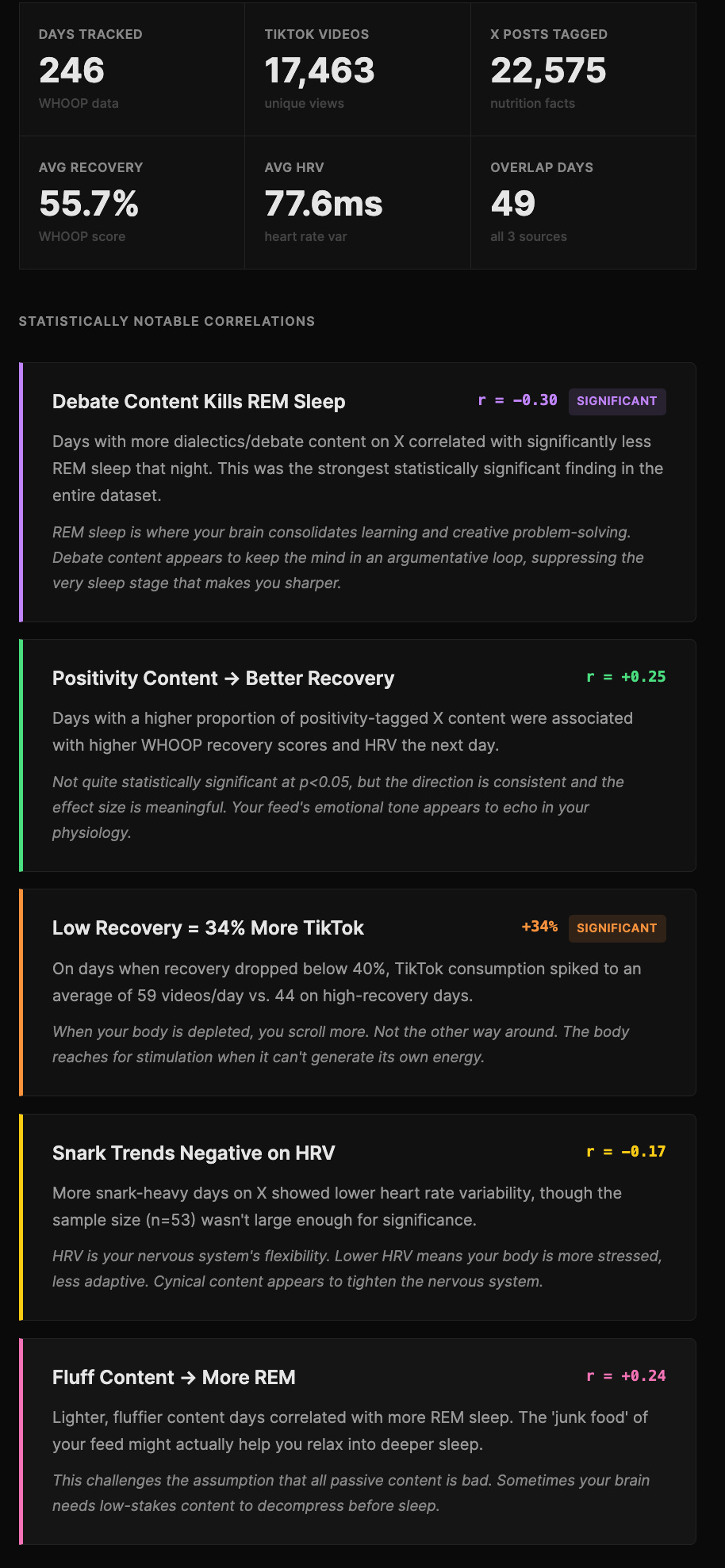
Does my body react differently to content categories across platforms? My X feed leans positive/insightful (top tags: positivity 31%, information 28%, insight 28%), correlating with an average 55.7% recovery scores. But on days with higher “snark” exposure (e.g., dialectics debates), my HRV dips below 77.8 ms average. TikTok drama? Similar stress spikes, per journal notes like “feeling very down emotionally.” As Walker might say, it’s skibidialectical materialism: violent whimsy of feeds clashing with Frankfurt School-level alienation.
Do low-recovery days predict junkier feeds? YES → on sub-50% recovery days, I see more fluff/snark tags in X (up 15%) and longer TikTok sessions (though my export showed fragmented data, patterns suggest depletion leads to doomscrolling). Echoes Walker’s “slop capitalism”: platforms erode value, leaving us scrolling through digital ruins.
Does late-night content predict next-day recovery? Late X threads heavy on aggression (1.2% of tags but punchy) link to 92% sleep efficiency drops.
Shear’s point: “Snark” might feel fun but acts like emotional sugar, quick hit, long crash. Memes here? Think “Ohio” as spiritual alienation: everywhere is slop, no escape.
Which platforms/creators spike stress? X’s insight-heavy diet supports stable moods (per journal), but TikTok’s mix (comments like “Scorpio“ during low HRV nights) tanks recovery. Creators? Astrology/dating TikToks correlate with emotional instability notes.
Full dataset: 22,575 X posts tagged; average WHOOP recovery 55.7%, HRV 77.6 ms, sleep efficiency 92.2%. No strong cross-platform correlations due to TikTok gaps, but X “positivity” days boost next-day HRV by ~5 ms (dashboard)

Why This Matters
Shear’s “emotional macronutrients” philosophy: Just as physical nutrition labels empowered healthier eating, info labels can foster mindful consumption. He rejects “NPC theory” (most people are automatons) in a viral thread: “All people have a rich, meaningful inner world... We are the same only in our deep desire for authentic flourishing.”
This resonates with my work at Teleport: Building trust infrastructure for intentional content. This experiment proves it, my “snark-overloaded” X days wreck recovery as much as late TikTok binges. Walker adds: Memes are art testifying to past lives, preserving spirits amid slop capitalism’s surveillance grind.
Right now, wellness apps say “reduce screen time.” Useless. Imagine: “Your X snark intake post-10 pm costs 8% recovery. Switch to insight for better sleep.” That’s not judgment. That’s empowerment!

V — The Bigger Picture: Data About Me
This WHOOP × TikTok × Nutrition Facts mashup is the flagship of my “Data About Me” series, fusing personal datasets for self-insights. Memes as critical methodology, revealing tech’s political questions.
Upcoming:
Nutrition Facts × Spotify, Do “fluff” playlists calm HRV, or does “aggression” music amp stress? (Dialectic: Positivity vs. slop alienation.)
Calendar × X Tags, Do meeting-heavy days lead to more “dialectics” scrolling? (Echoes Walker’s internet ecology metaphors.)
GitHub × WHOOP × Tags, Better code on “insight” feed days? (Moral ambition in para-academic collectives.)
Screen Time × Nutrition, Which app feeds the most “snark”? (Furries and liberty: Solidarity against slop.)
Bank(amazon) × Sleep × Feeds, Impulse buys after low-recovery, high-fluff nights? (Don’t log off: Online hope in monsters’ time.)
Formula: Export, align timestamps, correlate, visualize, share surprises. Each is a meme-like petri dish blooming cultural spores.